Guide
AI visibility platform: what it does and what to check before you pick one
An AI visibility platform shows whether ChatGPT, Google and Perplexity name you, and who they name instead. Here is what to check before you pick one.
The short answer
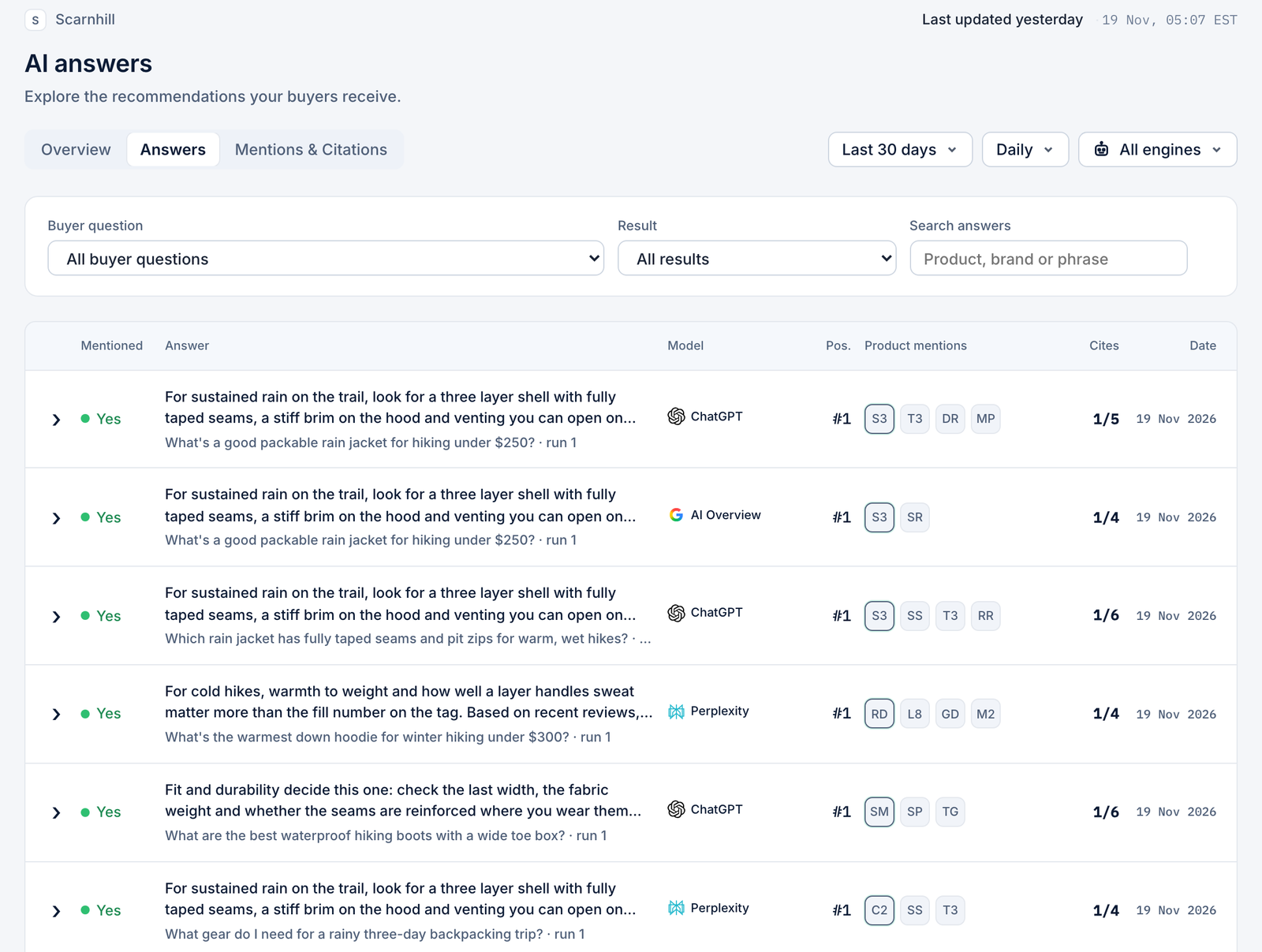
An AI visibility platform asks AI assistants the questions your customers ask and records who gets named. Most track. Fewer explain why. Fewer still help you fix it. Before buying, check which assistants it asks, whether it tells you which questions you can actually win, and what it does about a gap. We make one for Shopify stores, Produkto, so read our list of other tools too.
01
What an AI visibility platform does
It asks AI assistants the questions your customers ask, over and over, and writes down who gets named. The better ones also tell you what to change, or change it for you.
| Job | What it means | What you get |
|---|---|---|
| Track | Runs your questions in ChatGPT, Google AI Overviews, Perplexity and others, on a schedule | How often you're named, your position, and who's named instead |
| Explain | Reads the sources AI cites in those answers | The pages and sites that shape the answer, so you know where to show up |
| Fix | Turns gaps into work: page changes, articles, sites to pitch | A list of tasks, drafts, or changes made for you |
The difference that matters
Most platforms do the first job well. Fewer do the third. Ask every vendor one question: after you show me I'm missing, what happens next?
02
The question most platforms skip: which questions can you win?
Most platforms ask you to pick 25 to 75 buyer questions to track. Then they track all of them the same way. None of them tells you which ones you have a real chance at.
Why it matters
Some buyer questions are owned by one big brand that shows up in nearly every answer. Others are open: narrower, closer to what makes you different, with no clear winner yet. If you spread your effort evenly across both, you leave money on the table. Put it where you can actually win.
| Usually hard to win | Usually worth going after |
|---|---|
| Broad questions like "best coffee" or "best running shoes" | Questions with a constraint: a budget, a use, a need |
| Questions where one brand is named in most answers | Questions where AI already names you now and then |
| Questions answered mostly from big retailers' pages | Questions about what sets you apart (how it's made, who it's for, who makes it) |
In Produkto, each suggested question carries a label: Good chance, Fair chance or Hard to win, with the reasons, read from the answers to the questions you already track. It's a guide, not a promise.
03
What to check before you buy
Seven questions sort most platforms in a demo. None of them needs a technical background.
Which assistants does it ask?
This is what brands ask us first on demos. Your customers don't all use ChatGPT: some use Google AI Overviews, some Perplexity, some Gemini, Claude or Copilot. Check which ones are included and which cost extra.
Does it tell you which questions you can win?
Or does it leave you to guess? A platform should show which buyer questions are open to you and which one brand already owns.
How often, and how many times per question?
AI answers change from one ask to the next. A single reading tells you little. Ask how the platform deals with that.
Does it track your brand, or your products?
A brand can be named while its best product is never recommended. Online stores need product-level numbers.
Does it show who is named instead?
"You're missing" is half an answer. The useful half is who took your place and which pages AI read to pick them.
What does it do about a gap?
Report only, suggest tasks, or draft the change. If it drafts, check you approve everything before it goes live.
Can it show before and after?
The only way to know a change worked is to read the same questions before and after it, over weeks.
04
Why one reading isn't enough
Two numbers from our own answers show why a platform has to read the same questions again and again, on more than one assistant.
How often the same brand came first when the same shopping question was asked again in Google AI Overviews.
Produkto data, 106 pairs of AI OverviewsSame-day ChatGPT and AI Overview answers to the same shopping question that shared no brand at all.
From 856 real answers05
Which kind fits you
Pick the kind first, then compare names. Our comparison of ten AI visibility tools has the names, prices and who each suits.
| If you are | Look for |
|---|---|
| Just curious | A free check first. Ours, the free AI visibility checker, asks ChatGPT one of your buyers' questions. |
| A marketing team or agency | A tracker with many prompts, several brands and exports |
| Already on Semrush or Ahrefs | Their AI add-on, before a new tool |
| An online store | Product-level tracking and help fixing product pages |
06
Frequently asked questions
What is an AI visibility platform?
Software that asks AI assistants like ChatGPT, Google AI Overviews and Perplexity the questions your customers ask, records whether your brand or products are named, and shows who is named instead. Some also suggest or draft the changes to close the gap.
Is an AI visibility platform the same as an AI visibility tool?
Mostly, yes. "Platform" usually means it tracks several assistants and does more than one job, such as tracking plus content or page fixes. A single free checker is a tool.
Do I need one if I already do SEO?
SEO tools measure your position in the list of links. AI assistants write an answer, and it can leave you out while you rank well below it. You need something that reads the answer itself.
Can I start for free?
Yes. Google Search Console's Generative AI report, free AI visibility checkers and asking the questions yourself all cost nothing. Pay once you want to track changes over weeks.
Sources
- Produkto, How AI recommends products: 856 real answers.
- Produkto, Best AI visibility tools in 2026, facts checked on each tool's own site November 12, 2026.
See which of your products AI recommends
Produkto measures your whole Shopify catalog in ChatGPT, Google AI Overviews and Perplexity, and shows who AI picks instead.